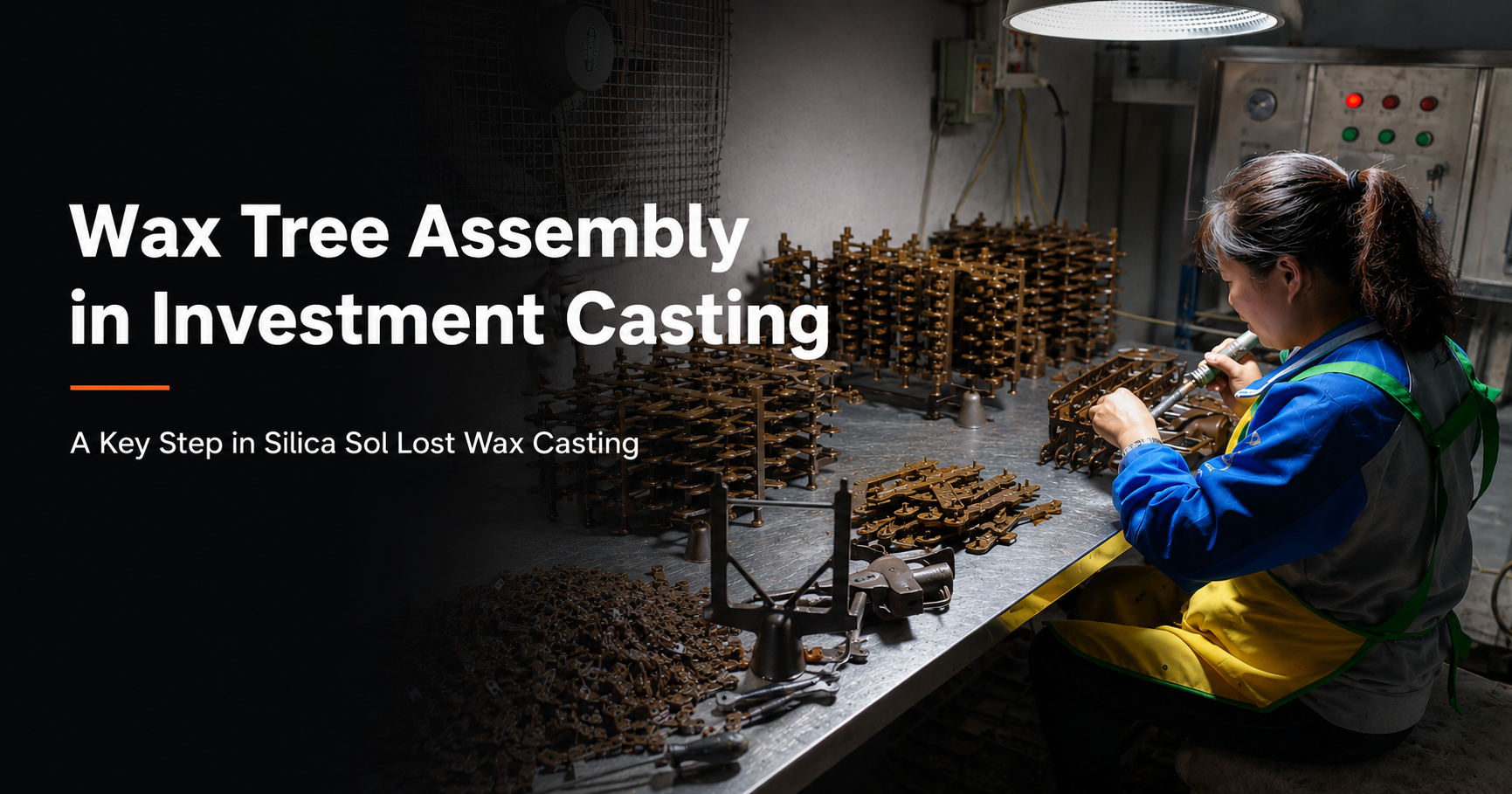
Wax tree assembly is an important step in the silica sol investment casting process. Before shell making and metal pouring, individual wax patterns are connected to a central runner system to form a complete wax tree.
Although this step looks simple, it directly affects metal flow, shell coating, casting defects and final product quality. For custom stainless steel, carbon steel and alloy steel castings, stable wax tree assembly helps improve production consistency and reduce casting risks.
In investment casting, wax patterns are first made according to the final part design. These wax patterns are then attached to a central sprue and runner system. The complete structure is called a wax tree.
After assembly, the wax tree will go through shell making, dewaxing, firing and metal pouring. During pouring, molten metal flows through the sprue, runners and gates into each casting cavity.
Because of this, the design and assembly of the wax tree have a direct influence on the final casting result.
A good wax tree helps molten metal fill each cavity smoothly and evenly. If the gate position, runner layout or wax pattern spacing is not suitable, defects may appear during production.
Wax tree assembly can affect:
Metal flow stability
Shell coating quality
Mold filling performance
Dimensional consistency
Surface quality
Production yield
Defect control
For repeat casting orders, wax tree assembly is not only about making one sample successfully. It is also about keeping the process stable during regular production.
Several details should be controlled during wax tree assembly.
First, the gate position should match the part structure, wall thickness and feeding requirement. A poor gate position may cause shrinkage, porosity, incomplete filling or poor surface quality.
Second, the wax patterns should have enough spacing. If the patterns are too close, ceramic slurry and refractory sand may not cover the wax tree evenly during shell making.
Third, the runner system should allow molten metal to flow smoothly. For complex parts, runner layout must be reviewed carefully to reduce turbulence and improve filling stability.
Finally, the full wax tree should be balanced and strong enough for handling, coating and drying. A stable wax tree makes the following shell making process easier to control.
Poor wax tree assembly may increase the risk of casting defects. Common problems include porosity, shrinkage, cold shuts, incomplete filling, deformation, dimensional variation and poor surface finish.
These defects are often related to several factors, such as part design, material, shell quality, pouring temperature and process control. However, proper wax tree assembly can reduce many risks before shell making and pouring.
This is why experienced foundries review the wax tree layout before production, especially for custom investment casting parts with complex structures.
In silica sol investment casting, the assembled wax tree is repeatedly dipped into ceramic slurry and coated with refractory sand. This forms a ceramic shell around the wax patterns.
If the wax tree is not assembled properly, the ceramic shell may have uneven thickness, weak areas or poor coverage. These problems may lead to shell cracking, deformation or casting defects during later production.
Therefore, wax tree assembly is a key preparation step before shell making.
At Senjia Casting, wax tree assembly is reviewed according to the drawing, material grade, part structure, wall thickness and production requirements.
Our process control focuses on proper wax pattern arrangement, suitable gate and runner layout, enough spacing for shell coating, stable tree structure and consistent assembly for repeat orders.
For custom investment casting projects, stable process control is more important than only making a single sample. Repeatability is critical for long-term production quality.
Wax tree assembly is part of the complete investment casting process. A typical process includes drawing review, mold development, wax pattern making, wax tree assembly, shell making, dewaxing, melting and pouring, shell removal, cutting and grinding, heat treatment, surface treatment, final inspection and packing.
Each step affects the final casting quality. Good wax tree assembly provides a stable foundation for the following production process.
Wax tree assembly is a key step in investment casting. It affects metal flow, shell making, defect control and final casting quality.
Senjia Casting provides custom silica sol investment casting and lost wax casting services for stainless steel, carbon steel and alloy steel parts based on customer drawings, samples and technical requirements.
If you need custom investment casting parts, please send us your 2D or 3D drawings, material grade, quantity and surface treatment requirements. Our team will review the casting feasibility and provide a quotation.
Contact: Terry Zhang
Phone: +86-13515399527 (Whatsapp/wechat)
E-mail: zhang@senjiagroup.com
Add: No 106 Jinqueshan Road, Linyi, China