Investment casting can produce metal parts with complex shapes, good surface quality and stable dimensions. However, like all casting processes, defects may still occur if the design, material, wax pattern, shell making, pouring or inspection process is not properly controlled.
For custom stainless steel, carbon steel and alloy steel castings, understanding common defects is important for both manufacturers and buyers. Good process control can reduce production risks and improve long-term casting quality.
Casting defects can affect the appearance, strength, dimensional accuracy and service life of metal parts. Some defects are visible on the surface, while others may appear inside the casting and can only be found through inspection.
For industrial parts, defect control is not only about appearance. It is closely related to product safety, assembly performance and working reliability.
This is why investment casting projects should be reviewed before production according to drawings, material grade, part structure, wall thickness, tolerance and application requirements.
Porosity is one of the common defects in investment casting. It usually appears as small holes or voids inside or on the surface of the casting.
Porosity may be caused by gas trapped during pouring, poor shell permeability, improper pouring temperature, material contamination or unsuitable gating design.
To reduce porosity, the casting process should control material quality, melting condition, pouring temperature, shell quality and gate design. For critical parts, non-destructive testing can be arranged according to customer requirements.
Shrinkage defects occur when molten metal contracts during solidification and does not receive enough feeding metal. These defects often appear in thick sections or areas where metal solidifies unevenly.
Shrinkage may reduce the strength and reliability of the casting.
To control shrinkage, the part structure, wall thickness, feeding position, gate location and cooling condition should be reviewed before production. A proper gating and feeding design helps improve solidification stability.
Cold shuts and incomplete filling happen when molten metal does not fully fill the mold cavity or when two metal flows meet but do not fuse properly.
These defects may be related to low pouring temperature, poor metal flow, thin wall design, complex structure or unsuitable runner layout.
For thin-wall or complex casting parts, the filling path should be reviewed carefully. Proper wax tree assembly, runner design and pouring temperature control are important for reducing these risks.
Deformation means the casting shape changes during production. It can happen during shell making, dewaxing, pouring, cooling, heat treatment or handling.
Long parts, thin-wall parts and asymmetric structures are more likely to deform.
To reduce deformation, the casting structure should be reviewed at the early stage. Process control during shell making, cooling, cutting and heat treatment is also important for dimensional stability.
Surface defects may include rough surface, sand inclusion, cracks, pits or uneven surface appearance.
These problems can be related to wax pattern quality, shell coating, ceramic shell strength, pouring condition or cleaning process.
In silica sol investment casting, shell making quality has a direct influence on the surface of the final casting. Stable slurry coating, proper drying and shell strength control help improve surface quality.
Dimensional variation is another important issue in custom investment casting. It may affect assembly, machining allowance and final product performance.
Dimensional variation can be caused by wax pattern shrinkage, mold condition, shell expansion, pouring temperature, cooling rate and post-treatment.
To control dimensions, the foundry should review drawings, tolerances and key dimensions before production. For important dimensions, inspection should be arranged before shipment.
At Senjia Casting, each custom casting project is reviewed according to drawings, material grade, structure, wall thickness, quantity and application requirements.
Our process control focuses on:
Drawing and casting feasibility review
Wax pattern quality control
Wax tree assembly control
Shell making process control
Melting and pouring control
Surface treatment control
Dimensional inspection
Final inspection before shipment
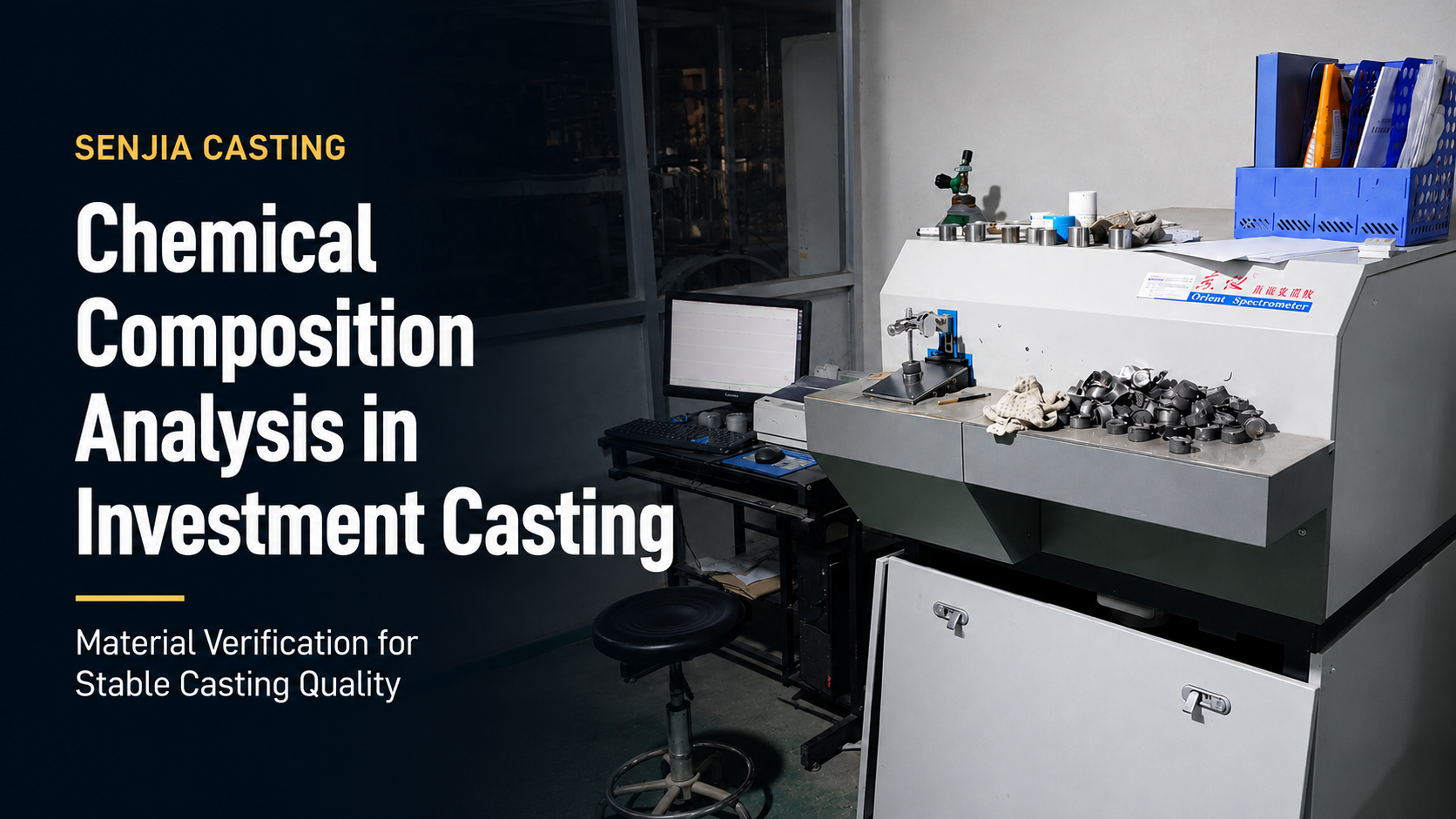
For special requirements, testing can be arranged according to customer needs, including chemical composition analysis, hardness testing, tensile testing, surface roughness inspection, 3D scanning and non-destructive testing.
Investment casting defects can be related to many factors, including part design, material, wax pattern, shell making, pouring, cooling and inspection. A stable process is necessary to reduce casting risks and improve production consistency.
Senjia Casting provides custom silica sol investment casting and lost wax casting services for stainless steel, carbon steel and alloy steel parts.
If you need custom investment casting parts, please send us your 2D or 3D drawings, material grade, quantity, tolerance requirements and surface treatment requirements. Our team will review the casting feasibility and provide a quotation.
Contact: Terry Zhang
Phone: +86-13515399527 (Whatsapp/wechat)
E-mail: zhang@senjiagroup.com
Add: No 106 Jinqueshan Road, Linyi, China